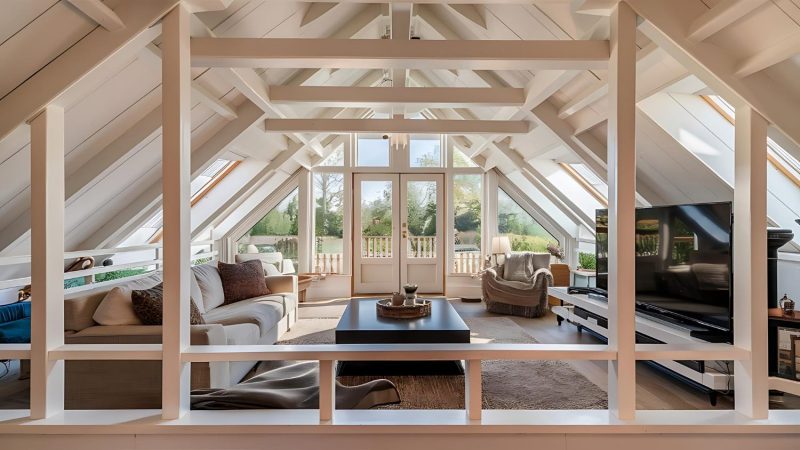
So, you’ve been staring up at that ceiling for a while now, thinking about what you could do with all that space just sitting above your head. Maybe it’s an extra bedroom, a home office, or even just somewhere to escape the kids for five minutes.
Whatever the reason, a loft conversion is one of the best things you can do with a Bristol home — and one of the first questions people ask us at ST Lofts is: do I actually need planning permission?
The honest answer? It depends. But don’t switch off — because by the time you’ve finished reading this, you’ll know exactly where you stand.
The Good News — Most Loft Conversions Don’t Need Planning Permission
Here’s something that surprises a lot of homeowners: the majority of loft conversions in Bristol fall under what’s called Permitted Development. That basically means you’re allowed to go ahead without applying for planning permission, as long as you stay within certain rules.
Think of it like this — imagine your neighbour Sarah in Redland decided to convert her loft into a master bedroom with an en-suite. She didn’t need planning permission because her conversion ticked all the right boxes. She was in and out within a few weeks, no council headaches. That’s the kind of experience most people in Bristol have. (This is a fictional example, but it’s a very common one!)
So what are those boxes you need to tick?
Permitted Development Rules — What You Need to Know
Under Permitted Development, your loft conversion is generally fine without planning permission if:
— The additional space created doesn’t exceed 40 cubic metres for a terraced house, or 50 cubic metres for a detached or semi-detached house.
— No part of the extension sits higher than the existing roof’s highest point.
— No verandas, balconies or raised platforms are included.
— Side-facing windows are obscure-glazed and cannot be opened (unless they’re above 1.7 metres from the floor).
— The materials used are similar in appearance to the existing house.
Most standard conversions — like a dormer at the back of the house — sit comfortably within these limits. But it’s always worth double-checking before you start, which is something we always do with our clients at ST Lofts before a single piece of work begins.
When You Will Need Planning Permission
Right, so when does it get more complicated?
There are a few situations where you’ll need to go through the formal planning permission process:
You live in a conservation area — Bristol has quite a few of these, including parts of Clifton, Cotham, and Redland. If your home sits within a designated conservation area, the rules are stricter. Any dormer windows visible from the street, for example, are likely to need permission.
You live in a listed building — Listed buildings require Listed Building Consent for any alterations, full stop. If you’re unsure whether your home is listed, you can check the Historic England website.
Your permitted development rights have been removed — This sometimes happens when a property is built as part of a newer development. Check your title deeds or give Bristol City Council a quick call if you’re not sure.
Your conversion exceeds the size limits — If you’re going big (and why not!), you may push past the Permitted Development thresholds. In that case, a planning application is the route to go.
Don’t Forget Building Regulations — These Apply to Everyone
Here’s something that catches a lot of people out. Even if you don’t need planning permission, you will almost certainly need Building Regulations approval. This is separate to planning permission — and it’s not optional.
Building Regulations cover the structural and safety side of things — things like fire safety, insulation, floor strength, and staircase dimensions. It’s basically the council making sure your new room is safe to live in. (Which, let’s be honest, is a good thing!)
At ST Lofts, all of our conversions are completed to full Building Regulations standards. We deal with the sign-off process as part of the project, so you don’t have to worry about chasing paperwork.
For a full breakdown of what’s actually checked and when Building Control gets involved, see our guide to Building Regs for a loft conversion in Bristol.
What About Party Wall Agreements?
If you live in a terraced or semi-detached house — which is most of Bristol, let’s be honest — you might need a Party Wall Agreement with your neighbours before work starts. This applies when the building work is on or near a shared wall.
It sounds more stressful than it is. In most cases, neighbours are completely fine with it once they know what’s happening. We always advise clients to have a chat with their neighbours early on — a friendly heads-up goes a long way!
So, What Should You Do Next?
If you’re thinking about a loft conversion in Bristol, the first step is a conversation — not a planning application. Get a professional in to look at your roof space, work out what’s possible, and advise on whether you’ll need permission. Nine times out of ten, you won’t.
At ST Lofts, we’ve done this hundreds of times across Bristol — from Clifton to Bishopston, Westbury-on-Trym to Bedminster. We know what Bristol City Council look for, we know the conservation area boundaries, and we’ll tell you exactly where you stand before anything else happens.
Get in touch with us today for a free, no-obligation chat about your loft. You might be closer to that extra room than you think!